Myths Reimagined - Fafnir

I have chosen to do a design for Fafnir from Norse legend, a dwarf who killed his father Hreiðmarr, stole the Ring of Andvari, and transformed into a dragon, all due to his insatiable greed.

This thread will follow my progress in designing, themes, inspirations, visual storytelling, and the interpretation of various parts of the myth into a sci-fi lens.

1 Like

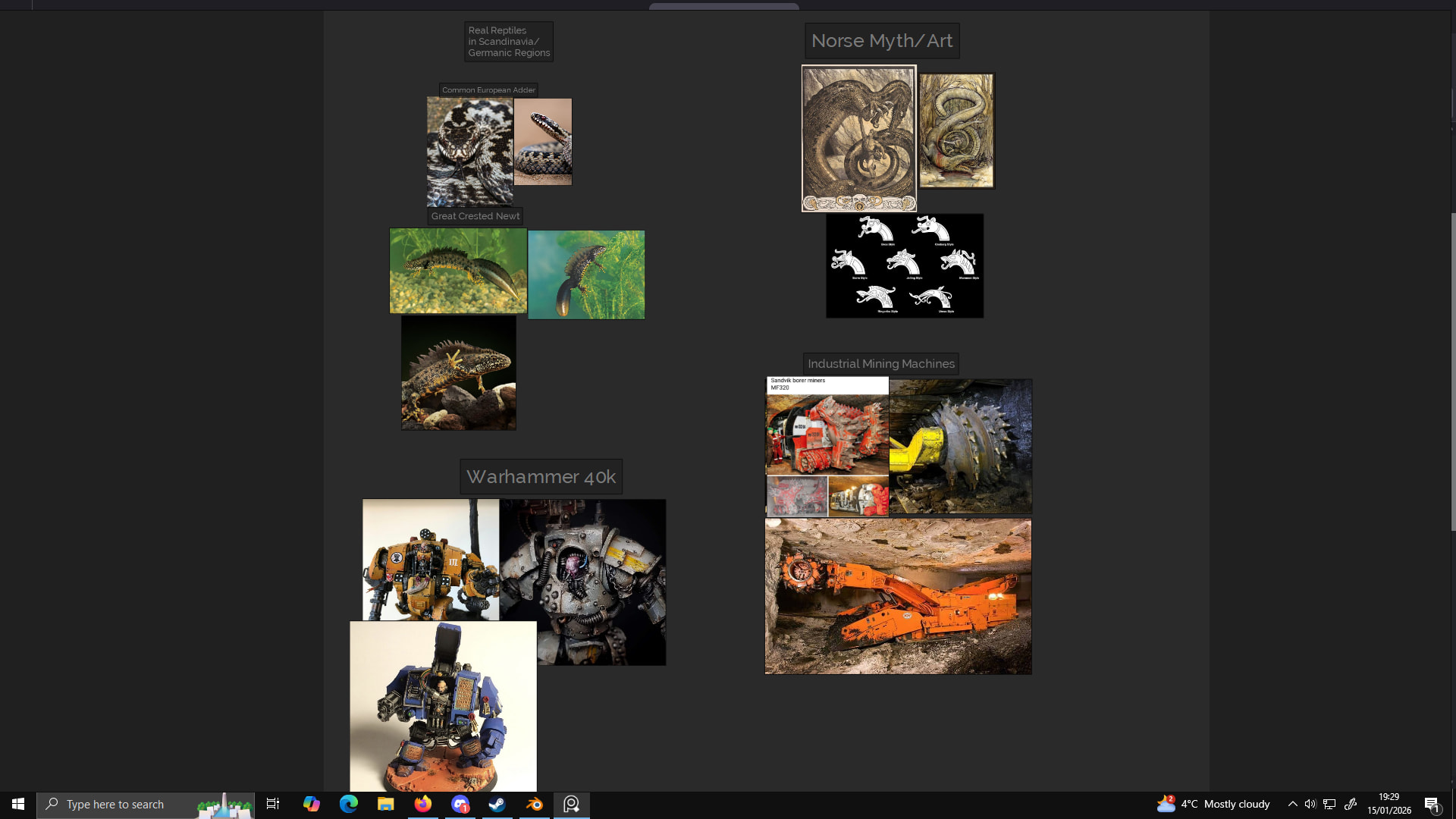
This is the setup of my moodboard and inspirations for this project.

I have chosen to use animals found in Scandinavian and Germanic areas for my body design inspiration, particularly the Common European Adder and the Great Crested Newt.

I have looked up a variety of mining machines for inspiration on armaments on this character model, along with Warhammer 40k’s Dreadnought for ideas on integrating the transformation process.

In Norse mythology, dragons weren’t the European fire-breathers we get in later works. They were large serpents and/or serpentine lizards that spat poison. Jormungandr and Nidhogg are two other examples from the mythos.

In Fafnir’s story, Andvari’s ring was enchanted by its creator to allow its user to find gold. When it was stolen by Loki it was cursed to bring misfortune upon its possessor. It ended up in the hands of Fafnir’s father, who was later killed by him out of greed, and Fafnir later dying to the hands of Sigurd.

In my sci-fi interpretation of Fafnir, the ring won’t be a worn item, but rather an electromagnetic array that lets an operator scan for minerals such as gold. This instrument will be retrofitted into a serpentine/draconic mech fitted with mining bits and somewhere on it, Fafnir will sit, not just piloting the mech, but integrated into it.

All images sourced from Pinterest.

1 Like

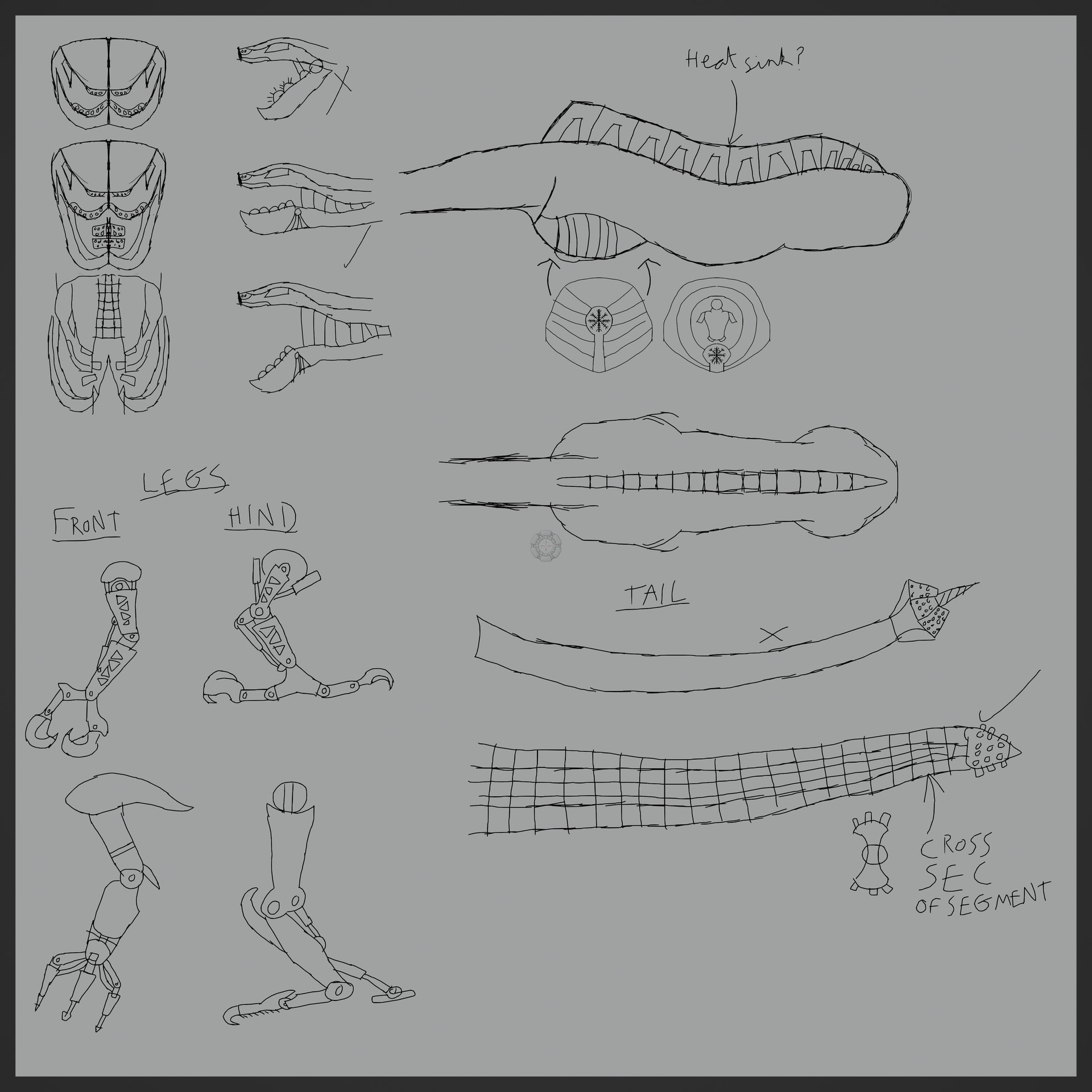
These are some rough concept sketches for the design I had in mind for Fafnir. I drew these in Blender via Grease Pencil, using the moodboard I created the other day for reference.

My primary thought with how I’m designing the “dragon“ body is modelling it after mining machines, but instead making a serpentine mech with various pieces of adapted mining equipment. I intend for the symbolism of the mining equipment to be an adaptation of Fafnir’s insatiable greed, using the mining capabilities to both defend his hoard and to mine more precious metal to add to his collection.

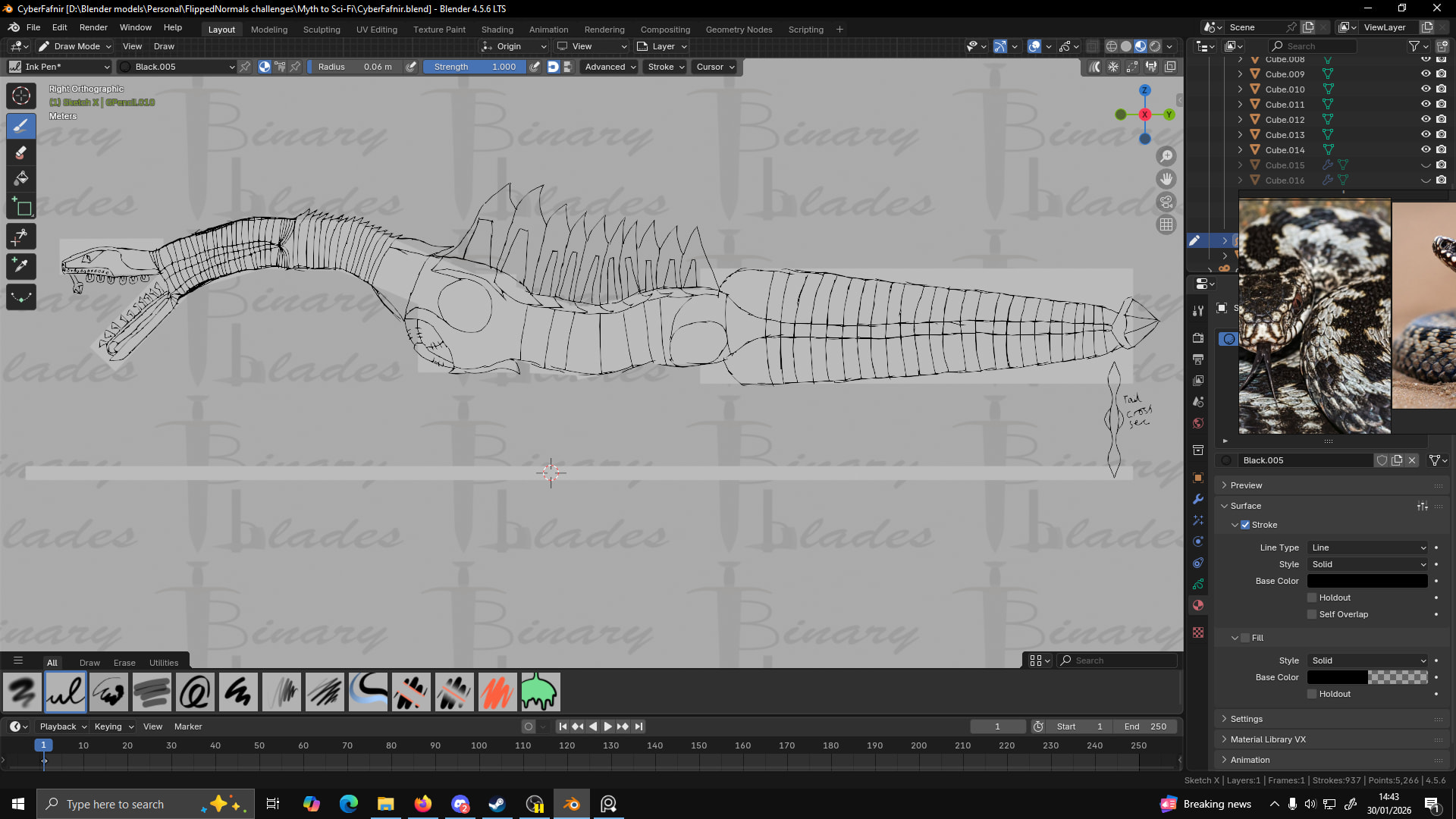
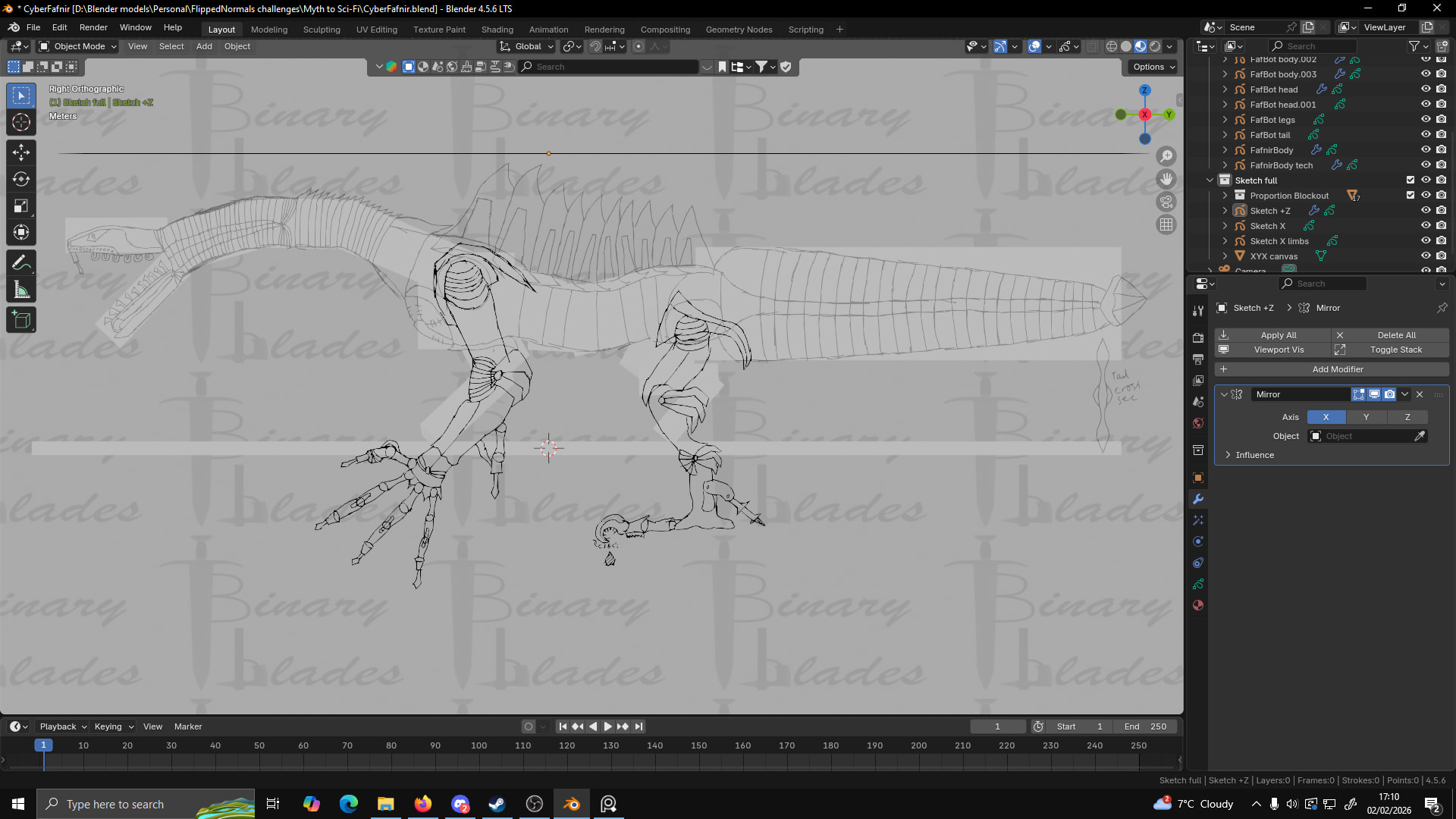
I’m currently undecided on the leg design, whether to make them more blocky and industrial (the first design, which is inspired by diggers) or sleeker and more advanced (second leg sketch, which is more generically sci-fi and uses friction stabilisation on the back legs and jackhammers for the front toes). Participants and peers, let me know which leg design would suit more, or if you have ideas of your own to support the design process.

The tail design is intended to spin and twist into a helical drill, using the Great Crested Newt’s tail as inspiration for the shape.

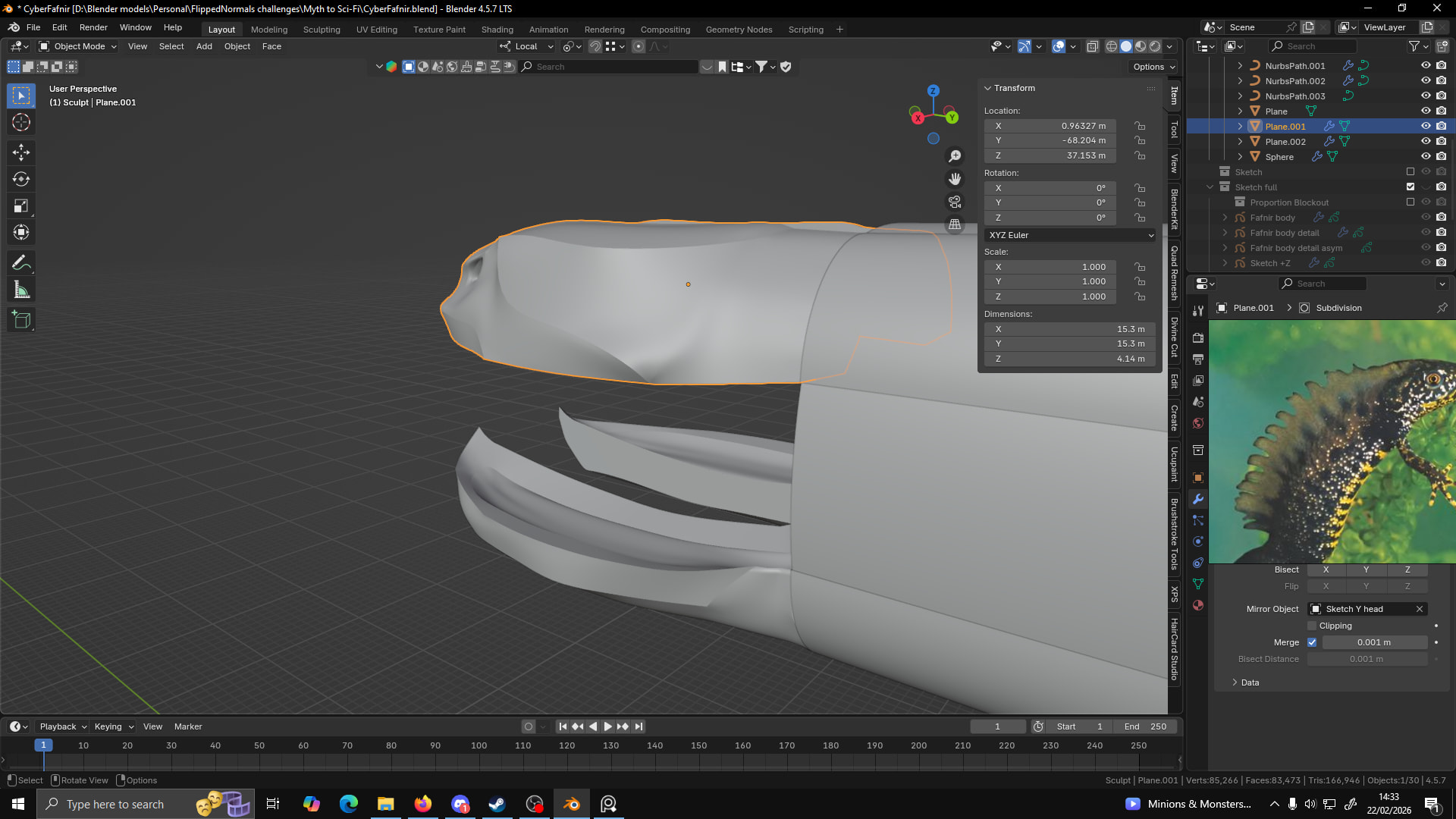
The head design uses the European Adder as a basis. Its head and neck will expand in order to intake larger loads of ore for processing and the snout will be lined with high pressure acid jets.

The chest cavity will host both Fafnir and the Ring of Andvari, which is a large electromagnetic metal detector array in my sci-fi interpretation of the myth. At the centre of the canvas, you might see the rough 3D model of the array.

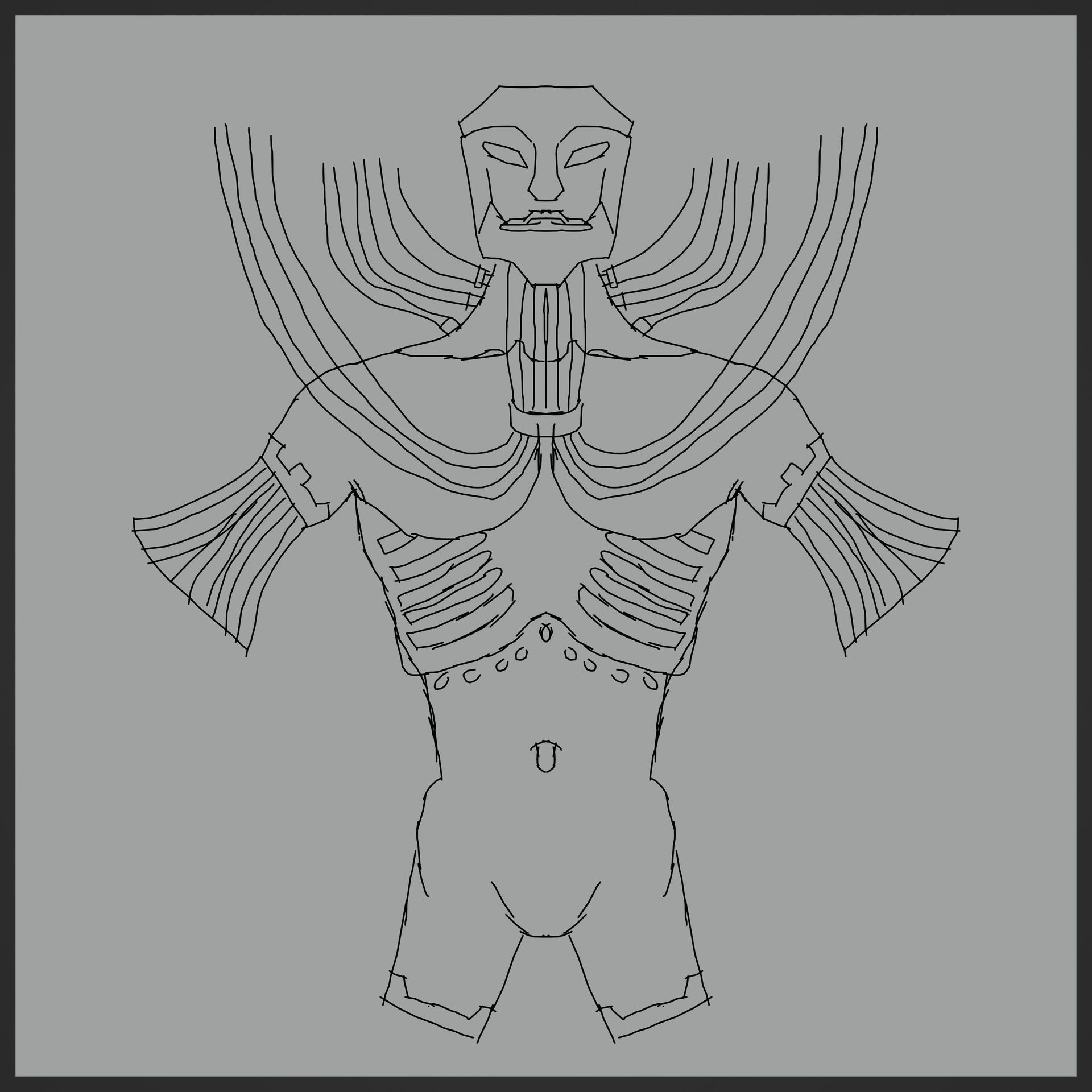
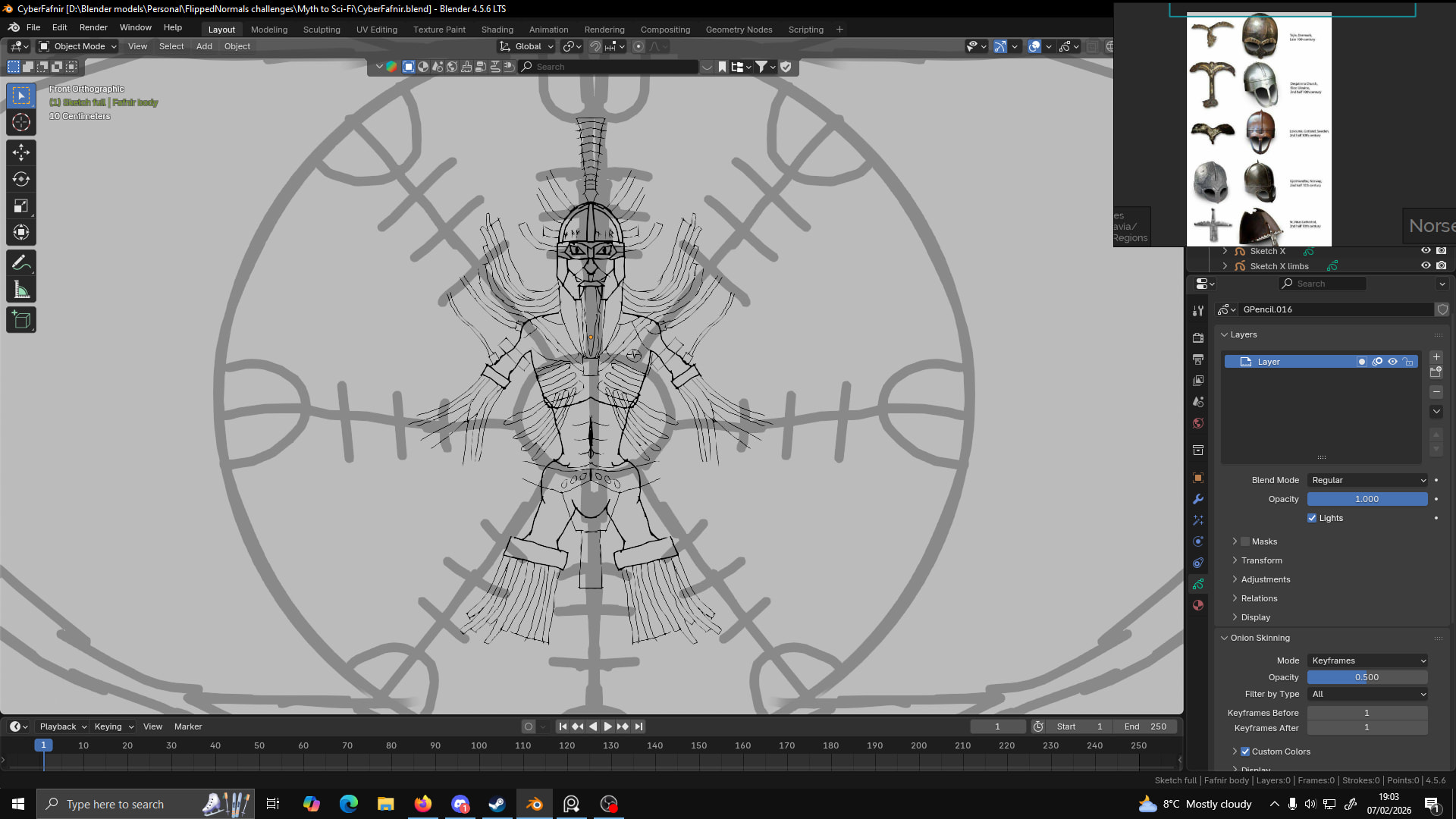
The second sketch is a rough idea for the body of Fafnir, located in the mech’s chest cavity. In the myths, he was able to change from dragon form to dwarf form freely, but after murdering his father and stealing the hoard, Fafnir remained in his dragon form until his death at the hands of Sigurd. In my sci-fi interpretation, I have chosen to make it so Fafnir is permanently attached to the mecha-dragon form through various invasive cybernetic uplinks and implants that replace most bodily functions. The body shape I’m intending here is stocky but emaciated, showing he’s no longer the operator, but the machine itself. In various myths and fantasy shows with Dwarves, they’re shown to have long beards, so to pay homage to that, the beard is instead the mask and uplink cables attached to Fafnir’s face.

I’d like to hear your thoughts, suggestions and feedback so far. And please forgive the roughness of my 2D drawing, they aren’t as honed as my 3D designing abilities.

2 Likes

An update on the sketch concept for my interpretation of Fafnir. I’ve begun making a full sketch of the idea which I’ll use as the basis of the body and mechanics on the body. Sorry for the space between progress, I had commissions.

(Note: between sessions, I changed the front fangs out in the image above from drills to jackhammers.)

In my design choices, I went for a hybrid between aesthetic, realistic/logical choices for design, and a new inspiration particularly for the limbs: the armour of Holy Roman Emperor Maximilian I.

The forelimbs are designed to have various shifts in movement to cover multiple angles at once for boreholes. In the place of talons I went for jackhammer bits.

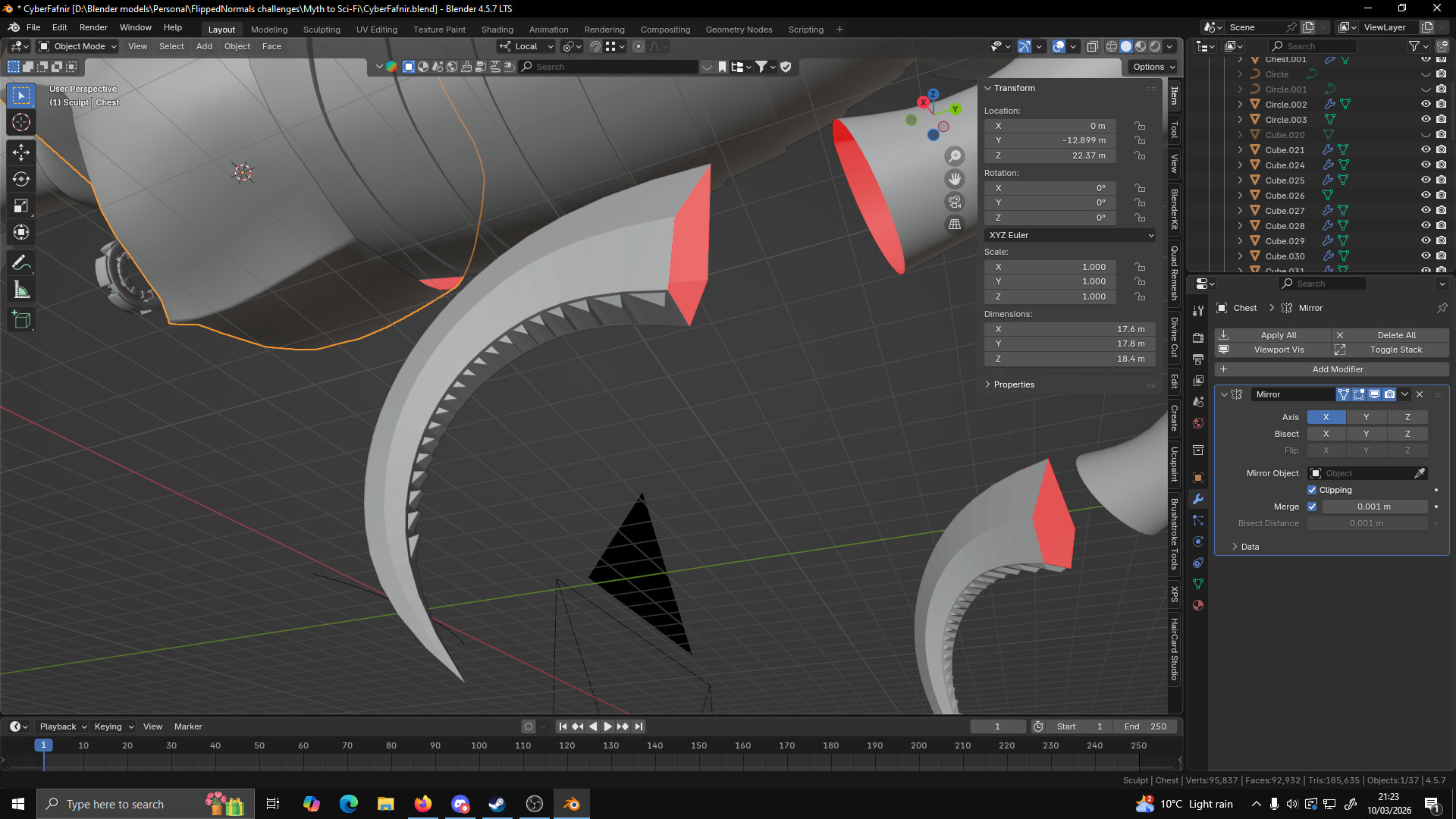
The hind limbs are designed for anchoring, friction, and maximising resistance to movement for heavy material removal and uphill/upright positions. The front claws are designed to dig into material and not slide back with a pentagonal cross section.

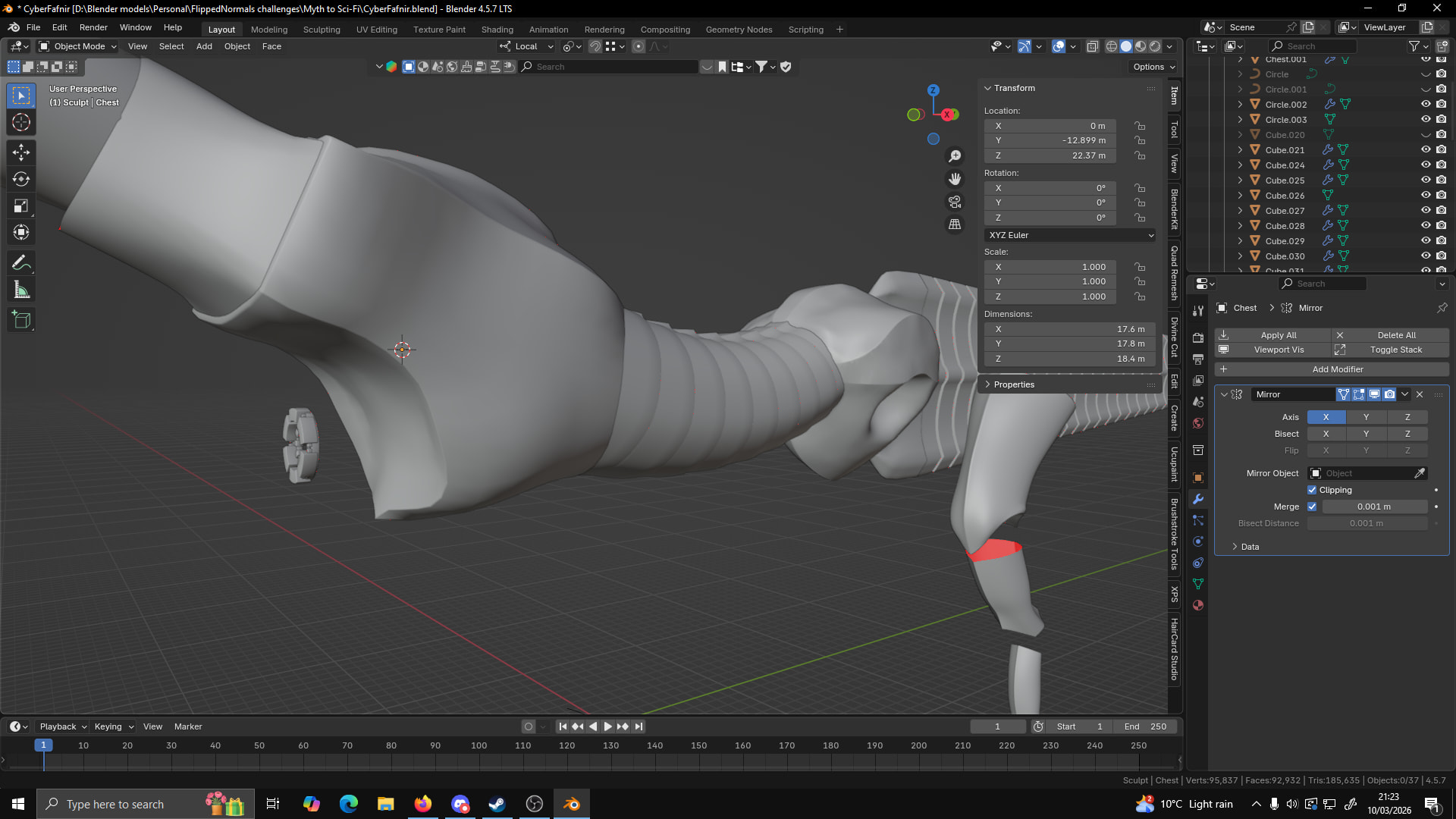
The joints and areas of articulation are inspired by armour design, and are designed to protect the machinery from debris and abrasive dust with downward slopes, overlapping lamellar plates, and covered pivots. This will also aid me in the model phase by removing the need to sculpt or model out a robotic joint with pistons and hydraulics.

The back will be a large radiator array with copper spines and thick overlapping armour plates to protect from cave-ins. A machine with a lot of enclosed systems makes a lot of heat and it’s got to go somewhere, so a cooling radiator using the Great Crested Newt for design inspiration would be a place for it to go. They’ll be able to fold down for tunnel operations.

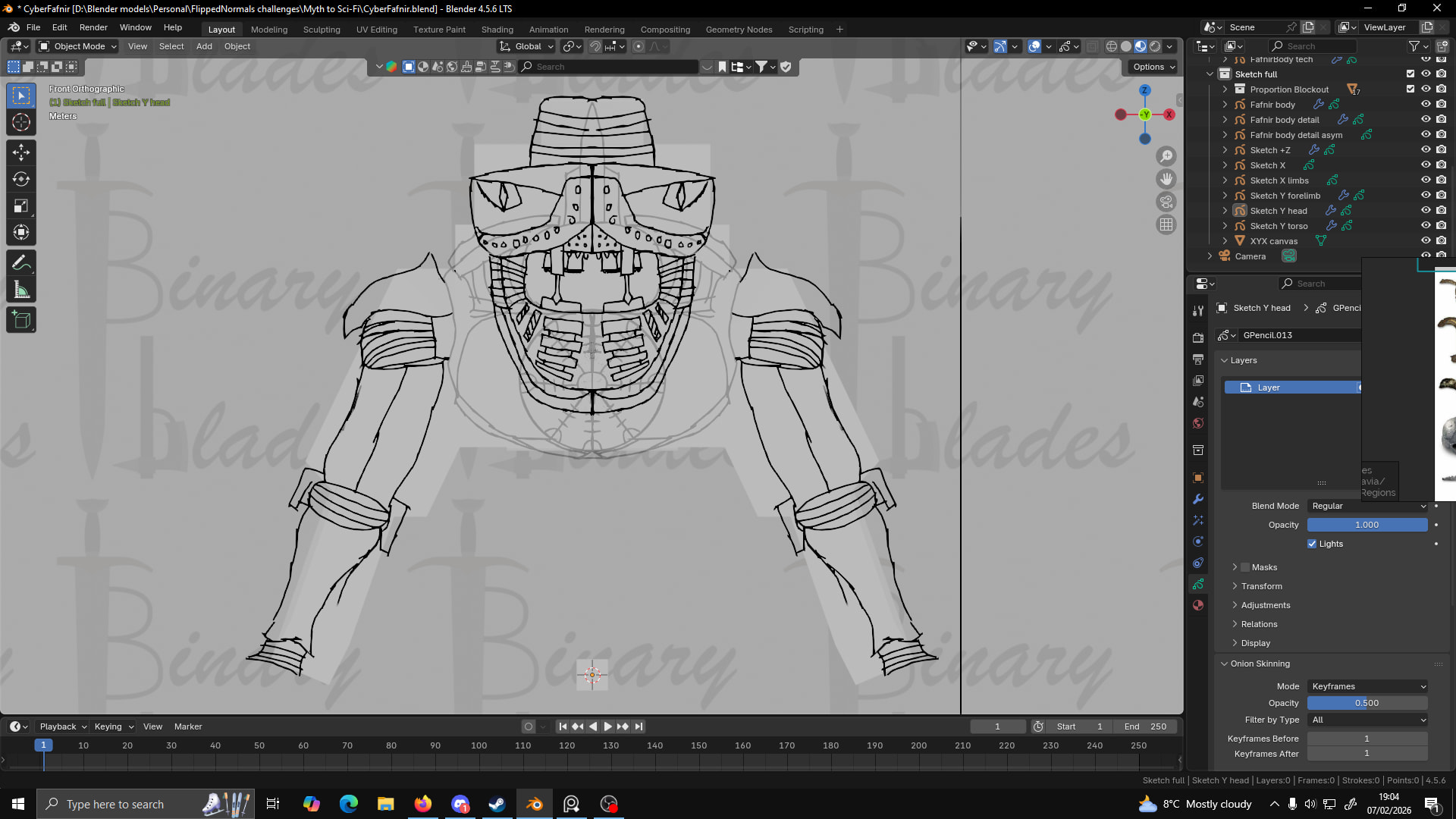
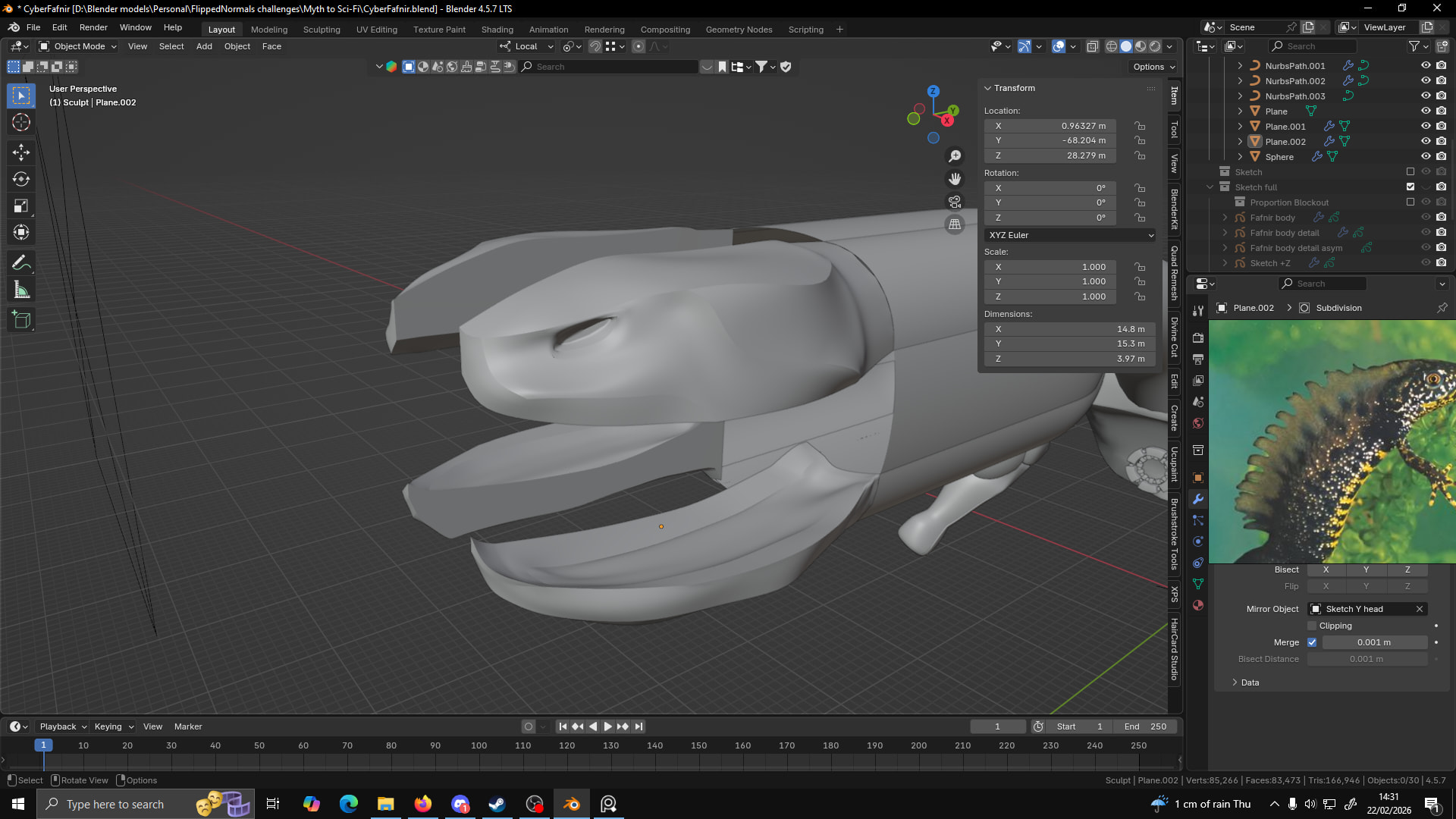
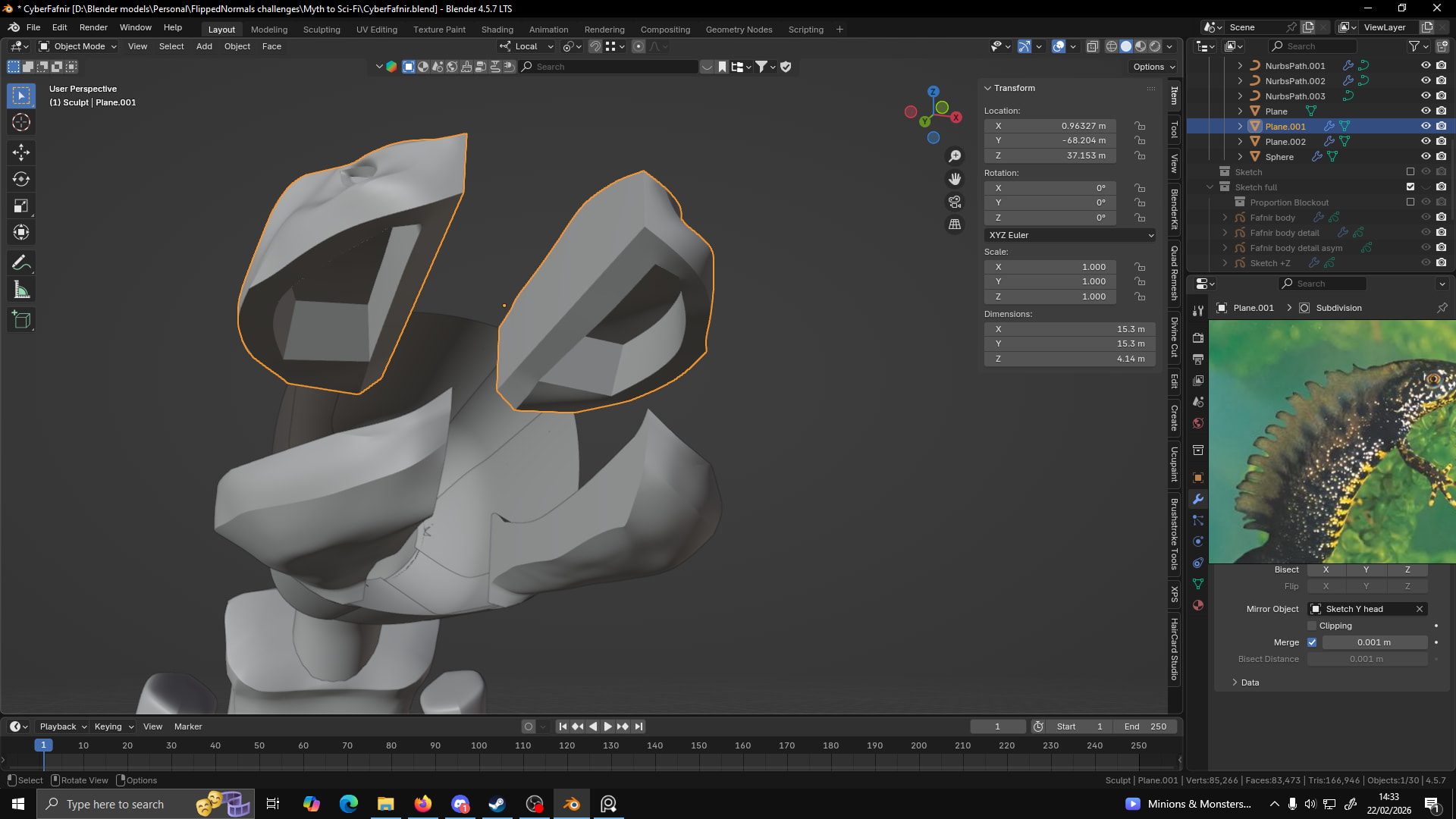
The neck and head are designed for flexibility and rapid material removal/storage. The front of the snout will be lined with acid spewers to dissolve/weaken rocks like limestone. The head will also be able to split apart and the throat can expand like a snake’s when swallowing wide loads for increased ore intake. The upper jaw will be an array of mining drills and jackhammers to remove material, while the lower is a conveyor to shovel it down the throat.

The tail will be a flexible, segmented drill that can twist into a helical shape for max material removal when working blind or backing up.

My entire design, overall, intends to adhere to the themes of Fafnir, the aesthetic design of Norse dragons, and what’d make sense for a mining mech with animal themes and complex joints to have for max wear/futureproofing. I also intend to make a documentary and timelapse video for my progress from final concept sketches to final model, for anyone more interested in that sort of content format.
Some more progress on the design of Fafnir.

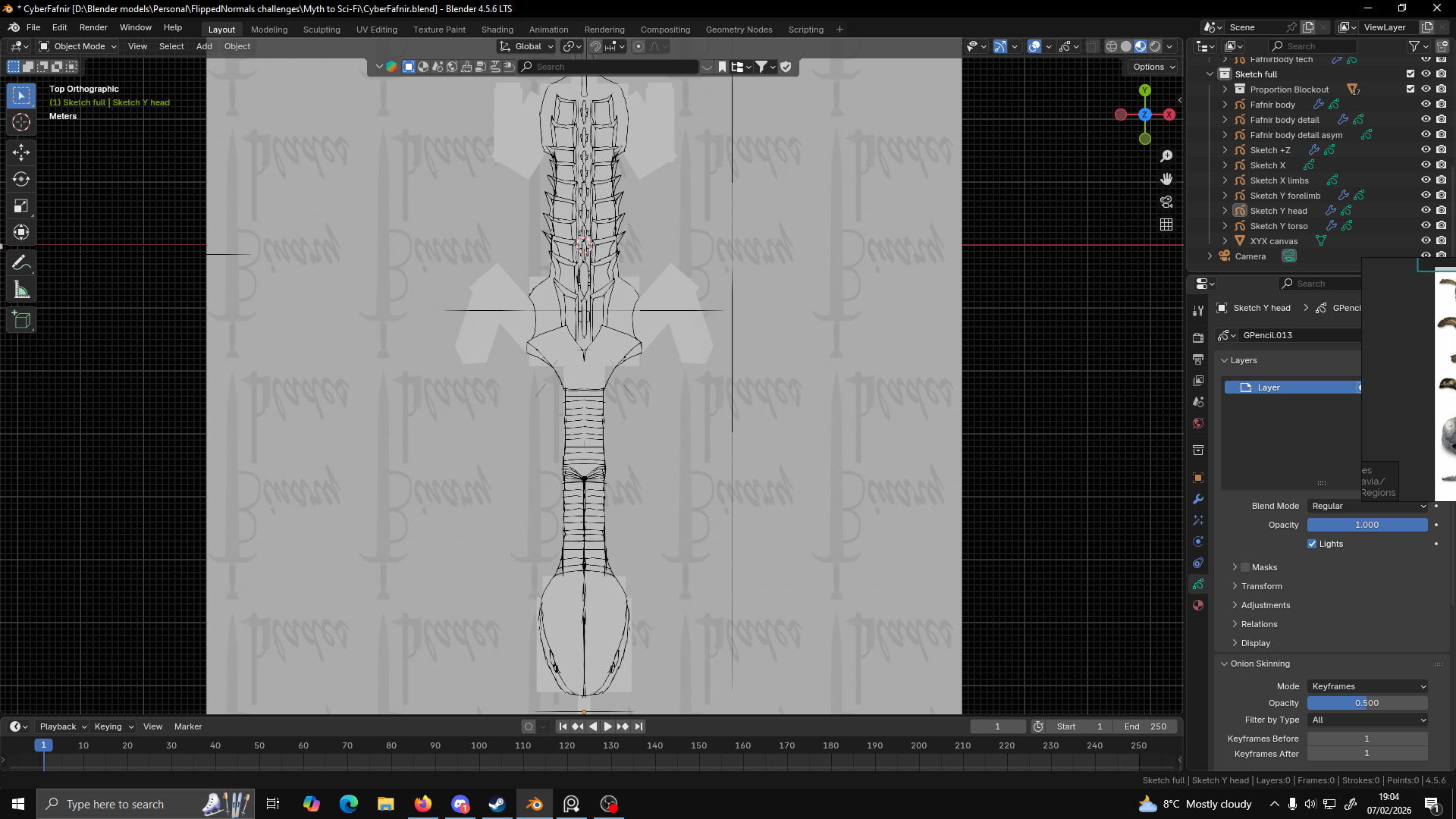
Top view. Thick overlapping armour plates designed to withstand the load and impact of cave-ins and assault from any attacker. In the myth, Fafnir’s hide was nigh-impervious to attack from most angles besides his underbelly. Gram was thrust into his heart by Sigurd from beneath.

Front view of the head. Shovelling coveyors and Archimedes screws in the lower jaw ensure ore and rock move down, while reciprocating pulverisers break it down in the throat. I still intend for the head to split four ways.

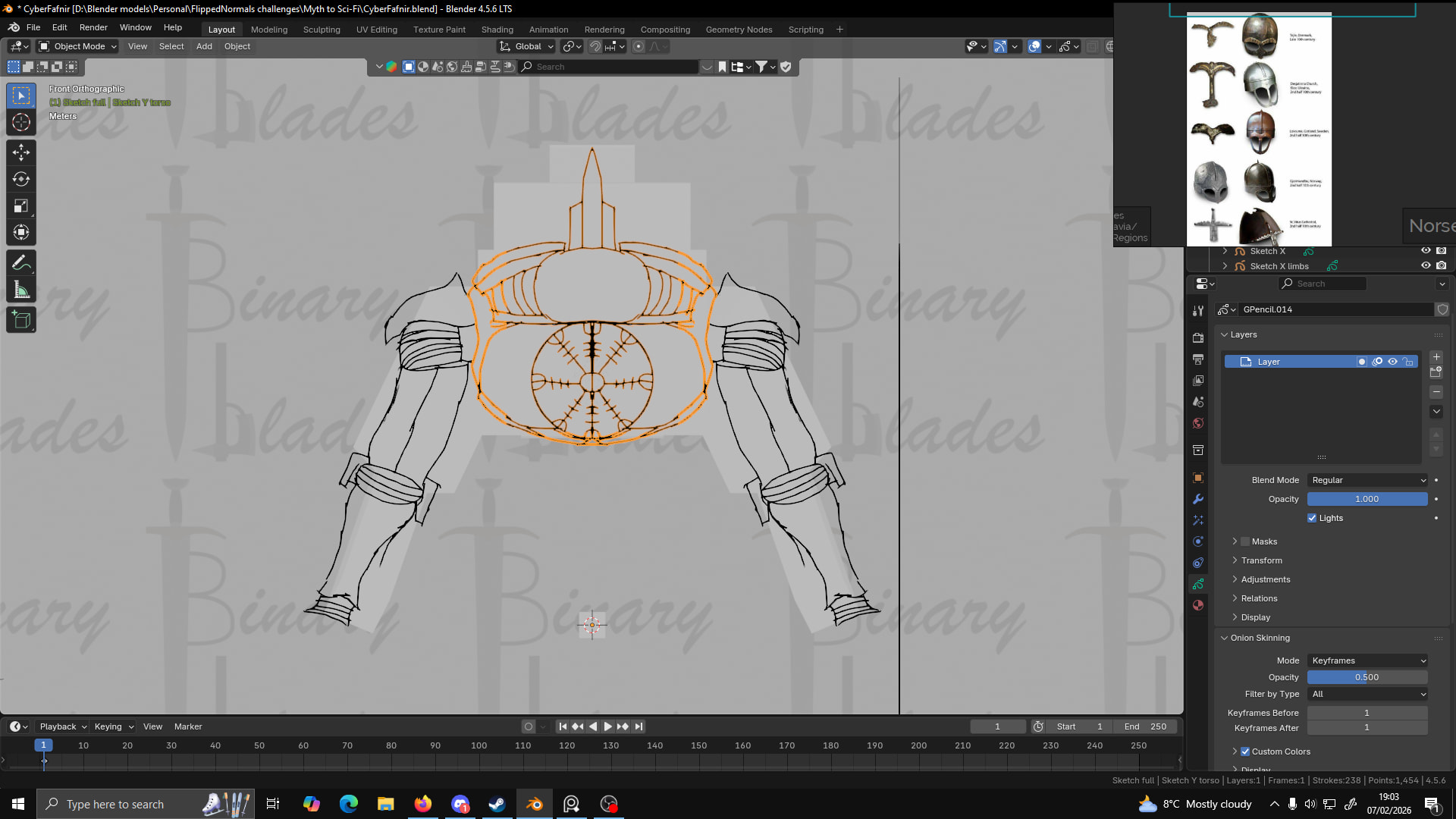
A preview of the torso without the head. A Helm of Awe protects the heart and most precious treasure of the monster, while segmented plates protect the moving parts of the mech. The Helm can open up as a multi-plated hatch when the Andvaranaut Array is being used. It also has a play on words, as a helm is where a ship is steered, and this is where Fafnir sits within the mechanical dragon.

The man who became a monster out of greed, Fafnir, sits at the heart. The body atrophies and wastes away from lack of use while his mind becomes the machine. Life support systems invade his body to keep the mind alive, while the limbs are lost and neuro-mechanical interfaces take their place for fine control over the mech. The mask is inspired by traditional helmets from the Dark Ages with hard surfaces and sharp corners from the sci-fi aesthetic. Fangs protrude from the helmet as an aesthetic choice for Fafnir’s deceit and new form, while the visor replaces his eyes with those of the mech’s.

I’m happy with how my sketch has turned out so far. I intend to begin modelling very soon. I plan to use a combo of poly and sculpting.

Modelling begins…

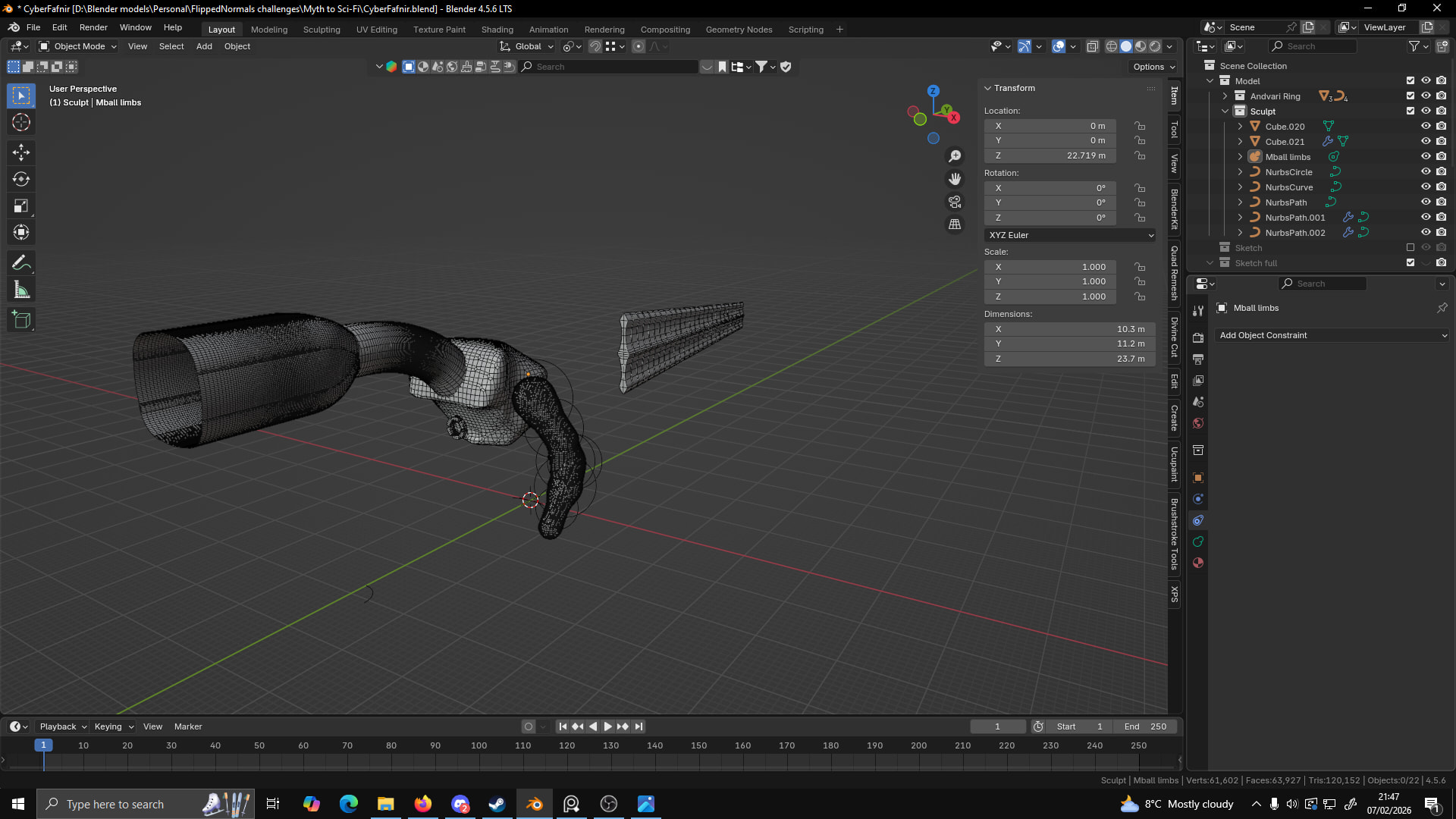
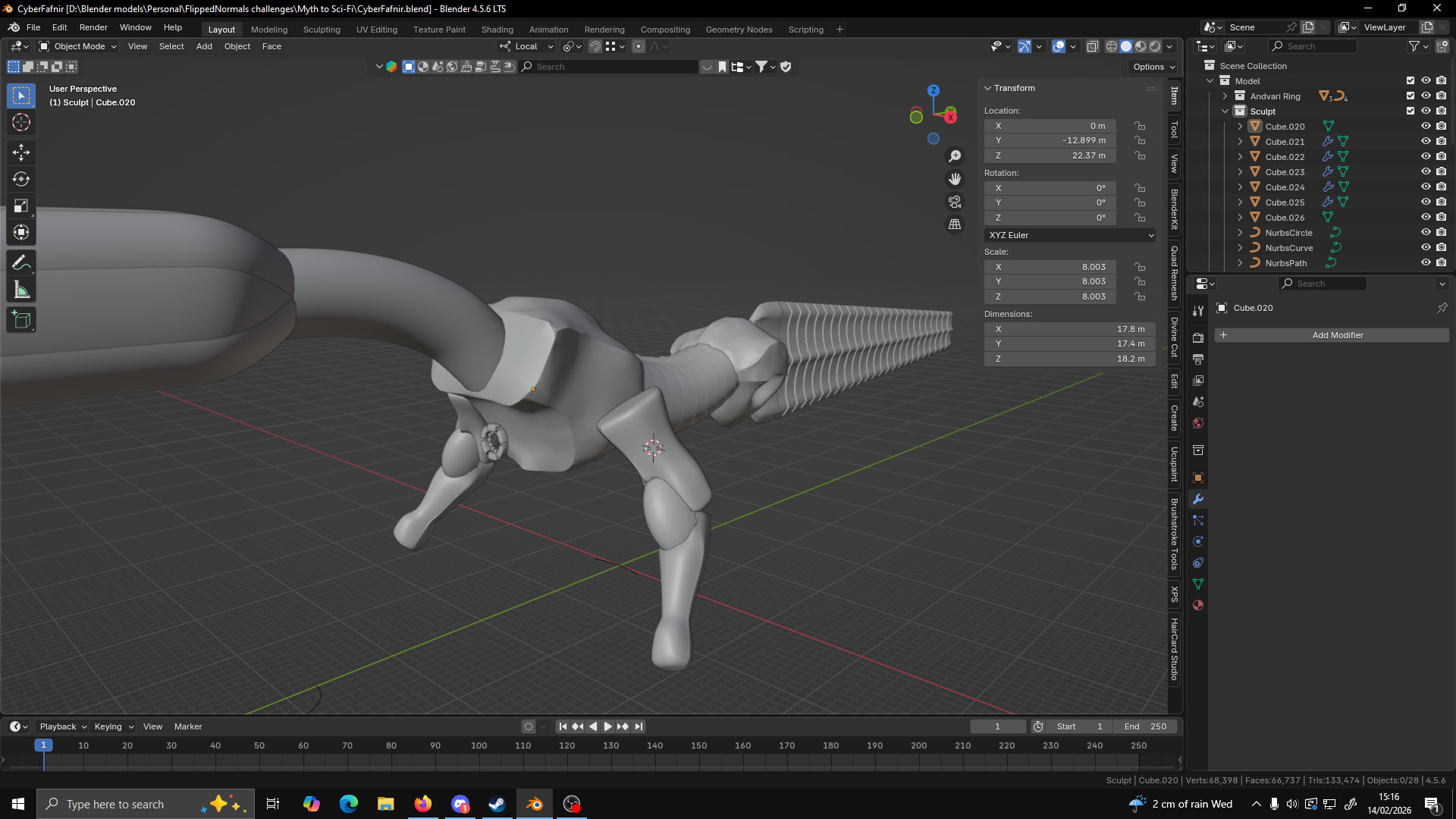
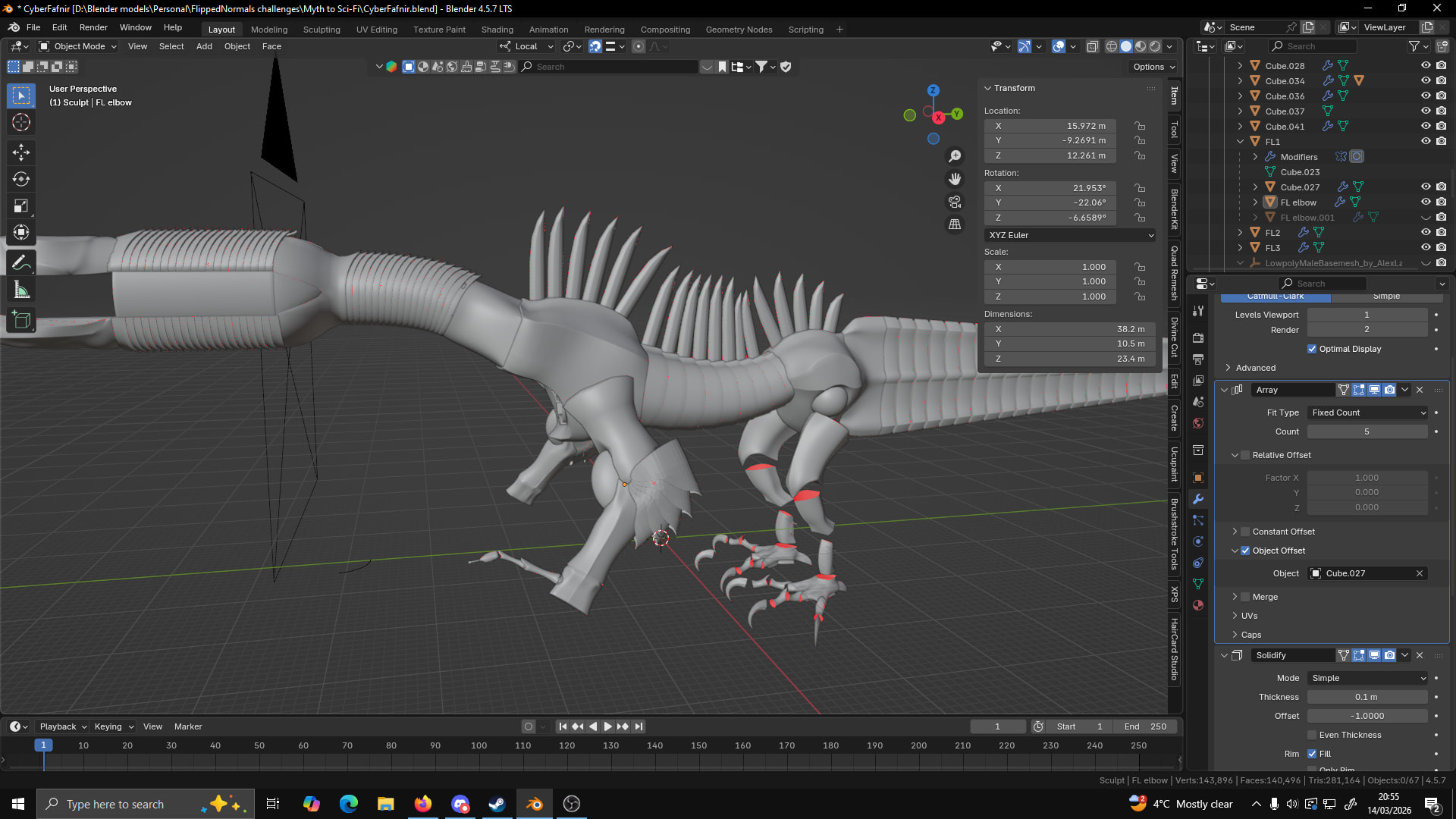
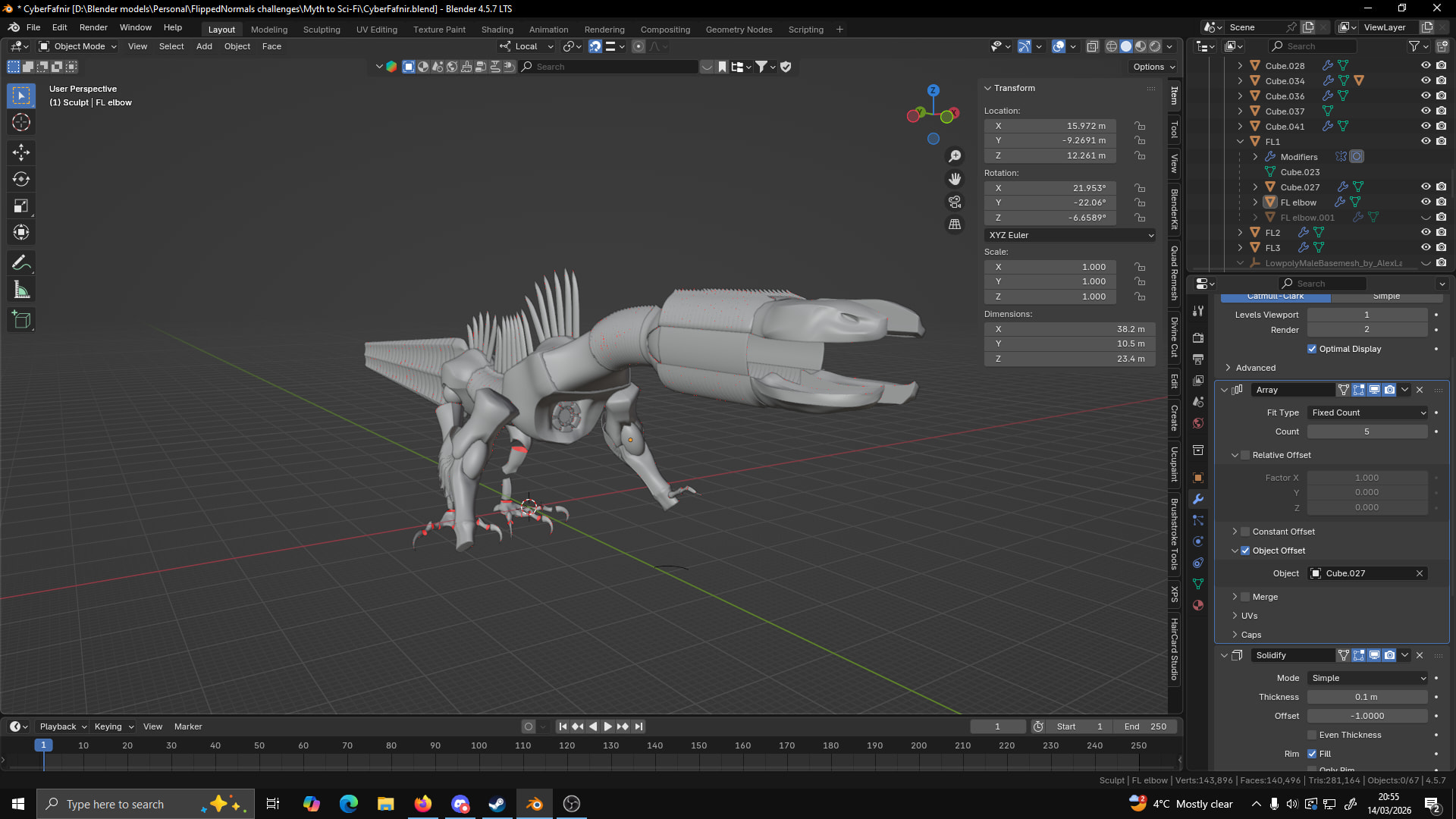
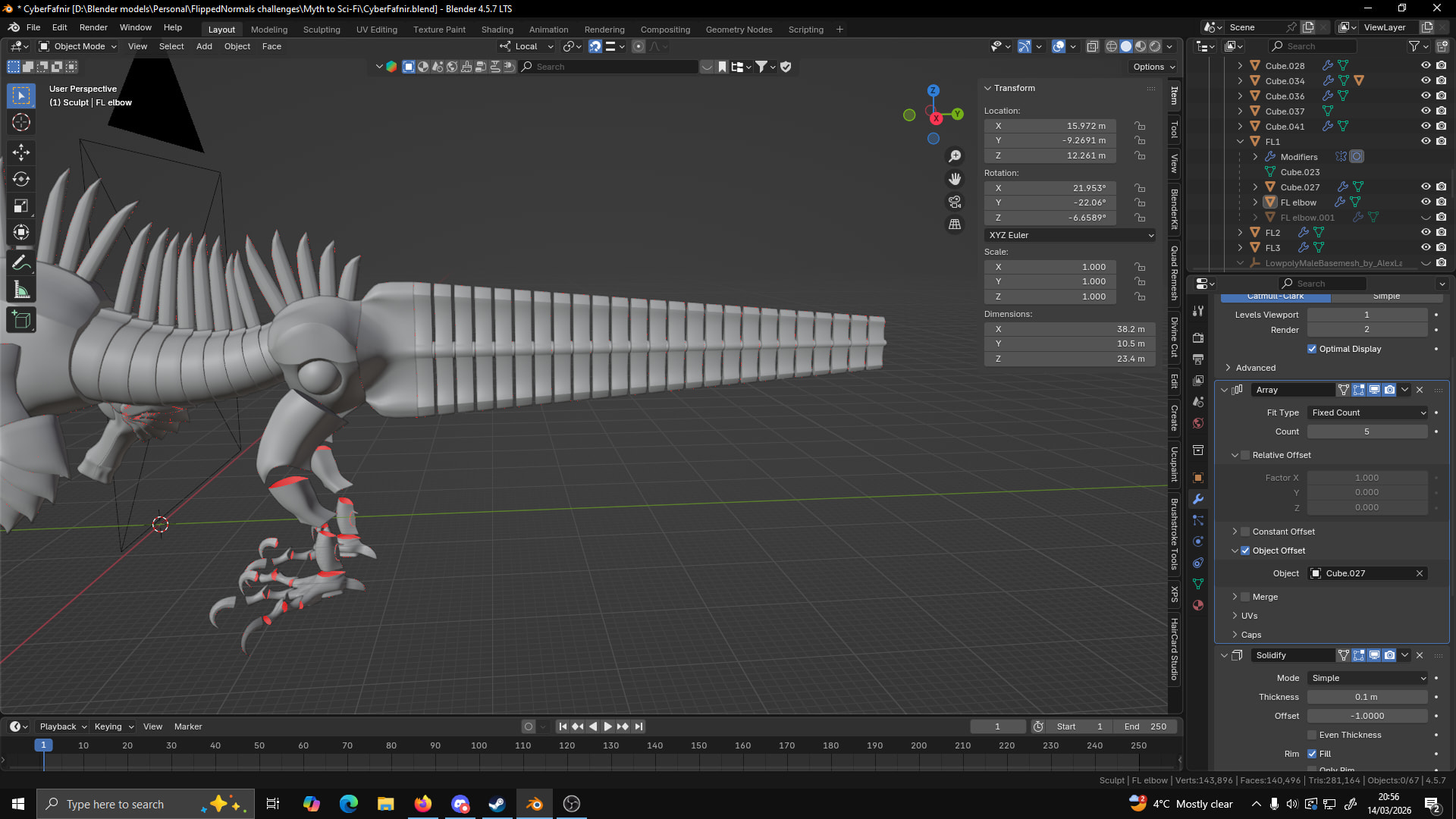
For now I’m blocking out the body profile with sculpting and various curves to see how it looks and tweak it before the quad topology begins taking precedent. The tail was done rather quickly with array and taper.

1 Like

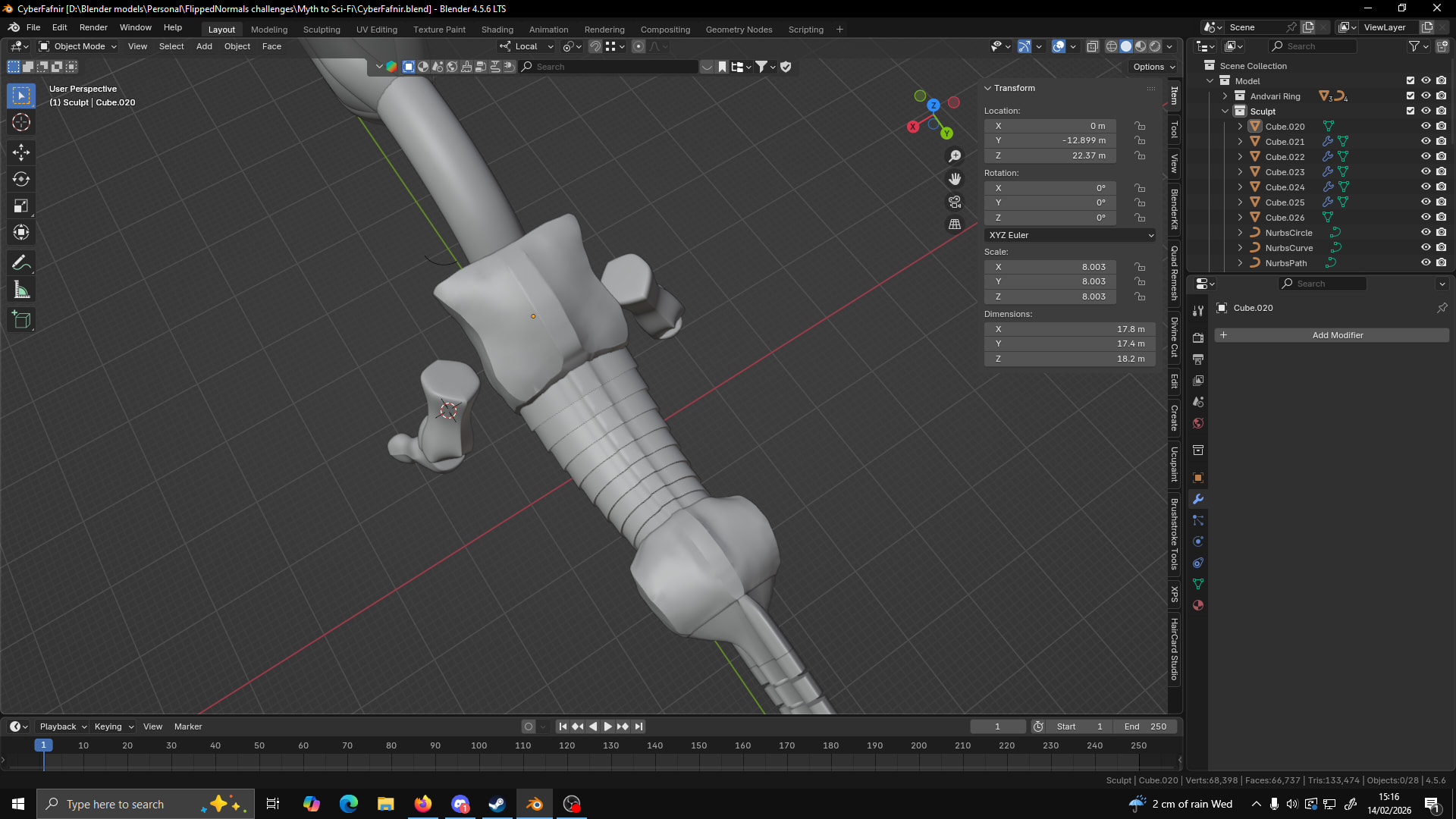
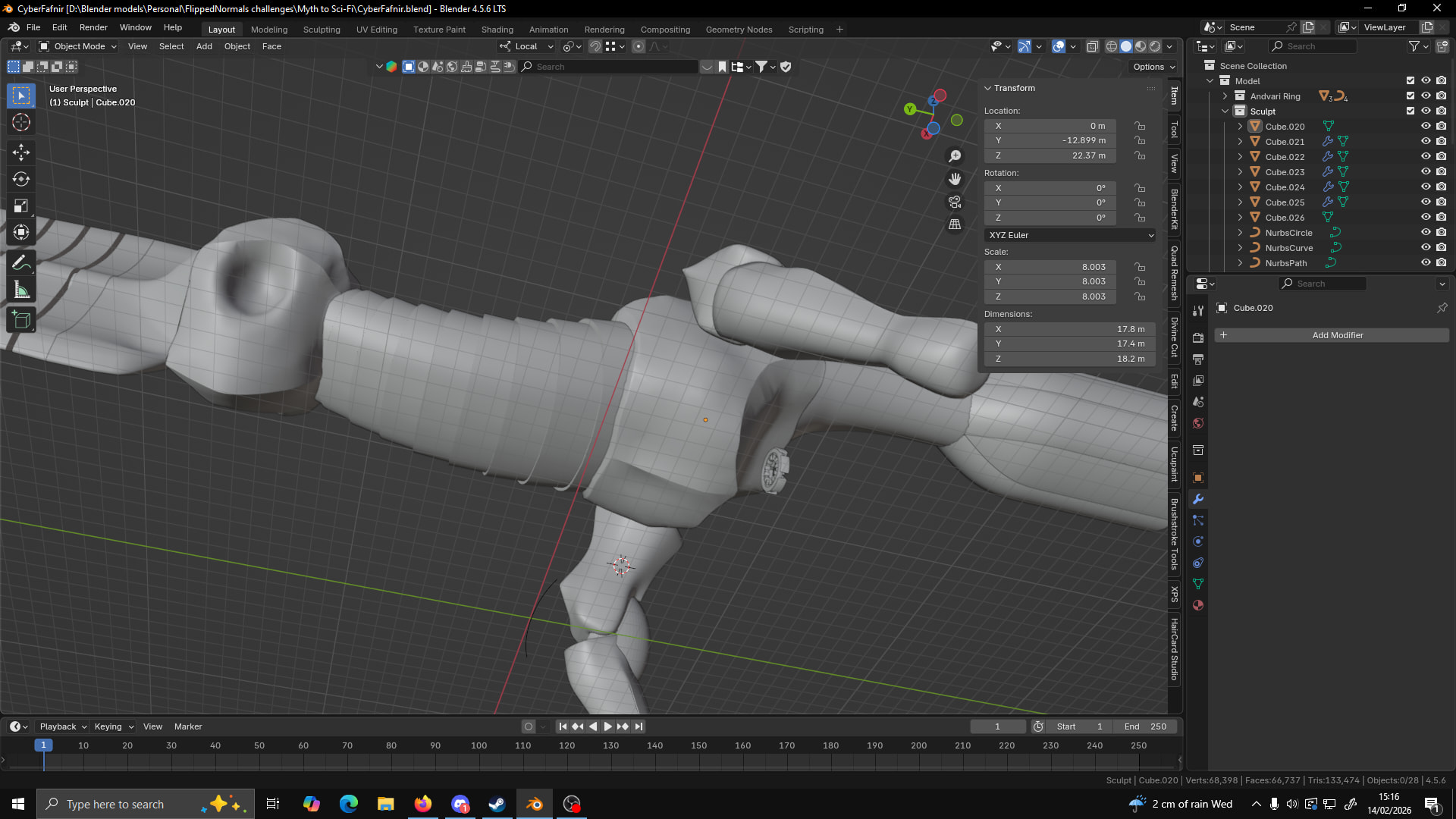
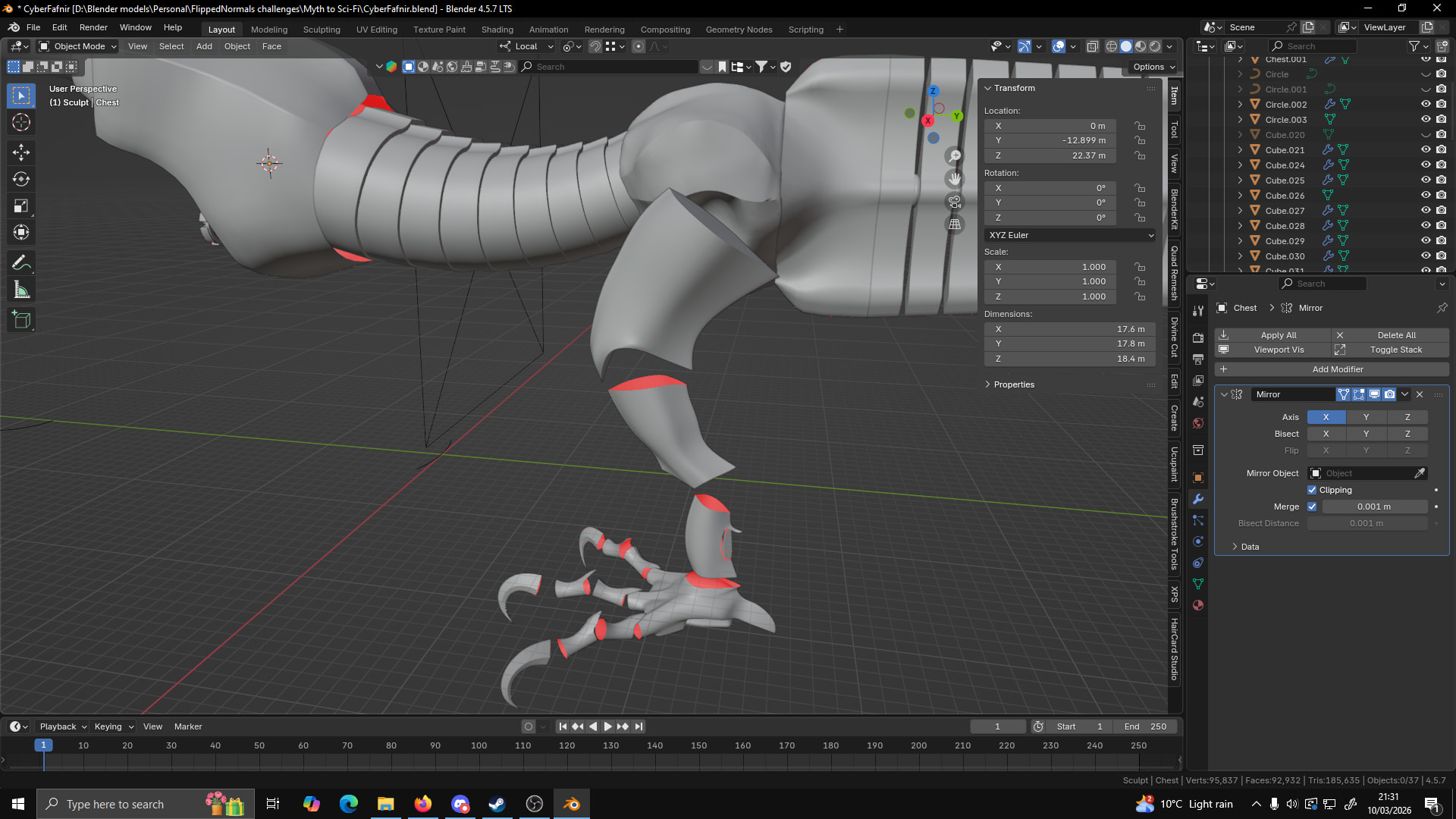
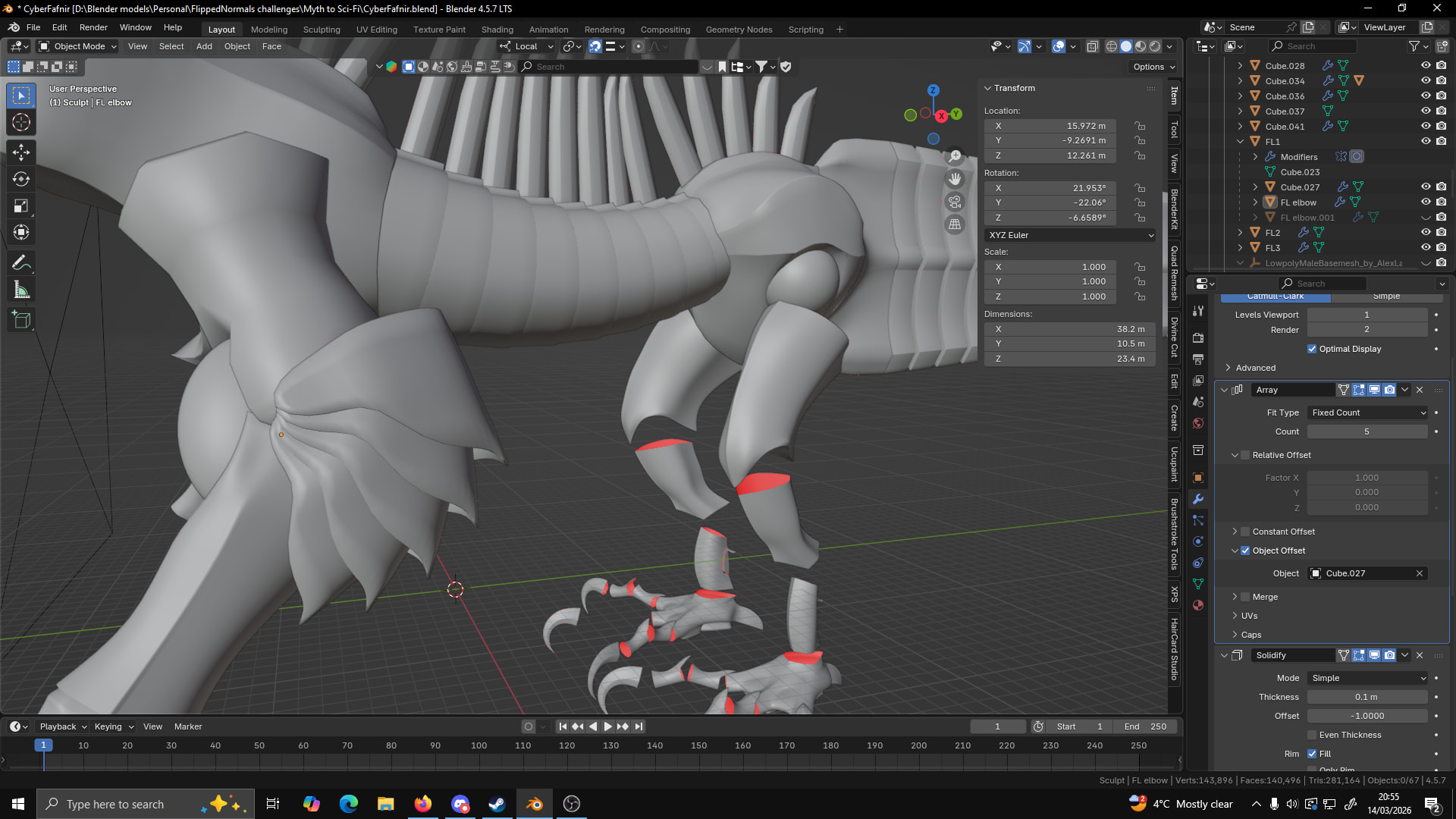
I’ve refined the rough silhouette sculpt for the chest, added the torso segments, refined the limbs using mesh instead of metaballs, and sculpted out the silhouette for the hip.

I’m aiming to create rigid sloping armour designed to glance and divert objects down and away with minimal contact. The intent of the slopes is to protect from cave-ins during operation and makes the design look sleek and lithe, like a snake.

The way I sculpted the chest and hip was I moved and sized the silhouette with the various grab tools until I was satisfied, then I used the crease and pinch tools to define the edges/hard surface, and used smooth to remove shading artefacts. Areas that won’t be seen were left rough for the time being. To create the rest of the torso I used Array with a scaled-down object to define offset to get that taper/telescopic look.